India-EU Summit: Free Trade Agreement Nears Finish Line Ahead of Republic Day Diplomacy
India and the EU are close to finalising a long-pending Free Trade Agreement during the 16th India-EU Summit on January 27, coinciding with Republic Day celebrations.
 aaravi_editor
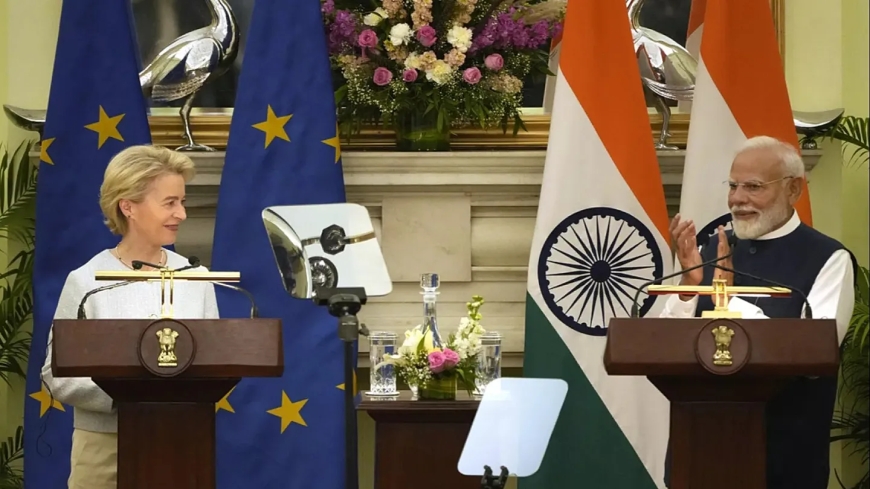
New Delhi is set for a crucial diplomatic and economic milestone as India and the European Union prepare to finalise a long-awaited Free Trade Agreement (FTA) during the 16th India-EU Summit scheduled for January 27. The summit coincides with India’s 77th Republic Day celebrations, where the EU’s top leadership will attend as chief guests.
The President of the European Council, Antonio Costa, and European Commission President Ursula von der Leyenwill be on a state visit to India from January 25 to 27 at the invitation of Prime Minister Narendra Modi. In addition to attending the Republic Day parade, the two leaders will co-chair the summit with the Prime Minister and hold meetings with President Droupadi Murmu, along with restricted and delegation-level talks with senior Indian officials.
An India-EU Business Forum is also expected on the sidelines, highlighting the strong economic focus of the visit.
At the centre of discussions is the proposed India-EU Free Trade Agreement, officially known as the Broad-based Trade and Investment Agreement (BTIA). Negotiations began in 2007, remained stalled for several years, and were revived in 2022 against a shifting global economic and geopolitical backdrop. Talks gained renewed momentum in February 2025 during Ursula von der Leyen’s visit to India, and officials now say a breakthrough is close.
Government sources indicate that 20 of the 24 negotiation chapters have already been concluded, with only a few sensitive issues remaining. The coming days are seen as decisive, particularly following Commerce and Industry Minister Piyush Goyal’s recent visit to Brussels, described by officials as a key push towards closure.
India’s Commerce Secretary has said there is strong political intent on both sides to conclude negotiations ahead of the leaders’ meeting, leaving open the possibility of a formal announcement during the summit. Notably, contentious agricultural issues—a major sticking point in earlier talks—have reportedly been kept outside the agreement, easing domestic concerns in India and several EU member states.
If finalised, the FTA would rank among India’s most significant trade agreements and represent a major strategic gain for the EU in Asia. It is expected to enhance bilateral trade, expand investment flows, and strengthen supply chains in sectors such as manufacturing, technology, clean energy, pharmaceuticals, and services. However, challenges remain, including market access in certain industrial segments and concerns over the EU’s Carbon Border Adjustment Mechanism (CBAM).
The broader political environment is favourable. India and the EU have been strategic partners since 2004, with cooperation deepening notably in recent years. The relationship gained further momentum following the historic visit of the entire EU College of Commissioners to India in February 2025. In October 2025, the EU Council also adopted a new strategic agenda for ties with India, focusing on prosperity, sustainability, technology, security, and global connectivity.
Against this backdrop, the participation of EU leaders as chief guests at the Republic Day celebrations is being viewed as a strong diplomatic signal. As President Costa recently remarked, India is a “crucial partner” for the EU. A formal announcement of the FTA on January 27 would cap nearly two decades of negotiations and mark a new chapter in India-EU relations.