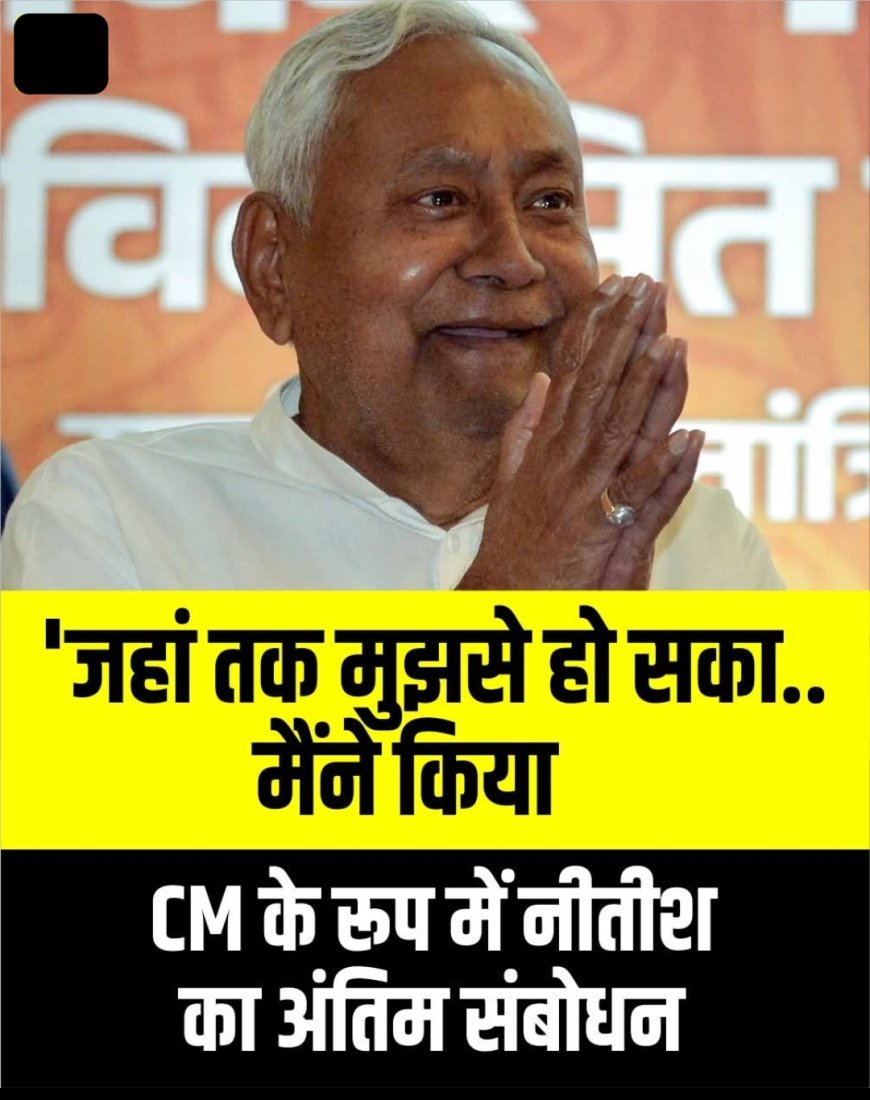
The farewell of Nitish Kumar from the post of Chief Minister of Bihar
For nearly two decades, Nitish Kumar remained at the center of Bihar’s governance, shaping policies, steering development, and influencing political alliances. His departure is not just a routine political transition—
 Avya7800
Early Political Journey
Nitish Kumar began his political career in the 1970s, inspired by socialist leaders and movements. He was influenced by the ideals of leaders like Jayaprakash Narayan, whose call for “Total Revolution” motivated many young leaders of that time.
He entered mainstream politics through the Janata movement and gradually built his reputation as a thoughtful, development-oriented leader. His early years in politics were marked by persistence and a focus on governance rather than rhetoric.
Rise to Leadership in Bihar
Nitish Kumar first became Chief Minister of Bihar in 2000 for a brief period, but his real tenure began in 2005. At that time, Bihar was facing multiple challenges:
Poor law and order
Weak infrastructure
Limited development
When he assumed office in 2005, expectations were high, and the state needed strong leadership. Over time, Nitish Kumar established himself as a leader capable of bringing administrative reforms and stability.
Governance and Development Model
One of the defining features of Nitish Kumar’s leadership was his focus on governance and development. His administration emphasized:
1. Law and Order Improvement
Bihar had long struggled with crime and lawlessness. Nitish Kumar’s government:
Strengthened policing
Introduced fast-track courts
Focused on reducing crime rates
This helped improve public confidence in the administration.
2. Infrastructure Development
Under his leadership, Bihar witnessed significant improvements in infrastructure:
Construction of roads and bridges
Better connectivity between rural and urban areas
Expansion of public transport
These developments played a key role in boosting economic activity.
3. Education Reforms
Nitish Kumar placed strong emphasis on education:
Recruitment of teachers
Opening of new schools and colleges
Schemes to encourage girl education
The cycle scheme for girls became particularly popular, encouraging school attendance among female students.
4. Women Empowerment
One of his most notable contributions was empowering women:
50% reservation for women in panchayats
Promotion of self-help groups
Policies supporting women’s education and employment
These initiatives significantly improved the participation of women in governance and society.
5. Social Welfare Programs
His government introduced various welfare schemes aimed at improving the lives of marginalized communities:
Support for backward classes
Development programs for rural areas
Focus on inclusive growth
Political Alliances and Strategy
Nitish Kumar’s political journey is also known for its complex alliances. Over the years, he worked with different political parties, including:
Bharatiya Janata Party
Rashtriya Janata Dal
His ability to navigate coalition politics became one of his defining characteristics. However, frequent changes in alliances also led to criticism from opponents.
Challenges and Criticism
Despite his achievements, Nitish Kumar faced several challenges:
1. Political Instability
Frequent alliance changes created uncertainty in governance.
2. Economic Limitations
Bihar remained one of India’s less industrialized states, with:
High unemployment
Migration of workers
Limited industrial growth
3. Opposition Criticism
Opponents often criticized his policies and decisions, especially regarding political alliances.
Leadership Style
Nitish Kumar is known for his calm, composed, and administrative approach:
Focus on governance rather than aggressive politics
Preference for policy-driven decisions
Emphasis on discipline and order
His leadership style contrasted with more aggressive political figures, making him a unique presence in Indian politics.
Legacy of Nitish Kumar
The legacy of Nitish Kumar is multifaceted:
1. Transformation of Bihar’s Image
He played a key role in changing Bihar’s image from a state associated with lawlessness to one focused on development.
2. Strengthening Governance
His policies improved administrative efficiency and public service delivery.
3. Social Reforms
His initiatives in education and women empowerment left a lasting impact.
Emotional Farewell
The farewell of Nitish Kumar is an emotional moment for many in Bihar:
Supporters see him as a leader who brought stability
Critics acknowledge his long service to the state
Political leaders across parties have recognized his contribution
Such moments highlight the human side of politics, where leadership transitions carry both political and emotional significance.
Transition to New Leadership
With Nitish Kumar stepping down, Bihar is entering a new phase. Leaders like Samrat Chaudhary are emerging as key figures in the state’s politics.
This transition represents:
A shift toward new leadership
Changing political dynamics
New opportunities and challenges
Impact on Bihar’s Future
The departure of Nitish Kumar will have lasting effects:
Policy continuity vs. change
New governance priorities
Public expectations from new leadership
The coming years will determine how Bihar builds upon his legacy.
National Significance
Nitish Kumar’s political career has also influenced national politics:
Played a role in coalition governments
Contributed to debates on development and governance
Represented regional leadership at the national level
His departure will be felt beyond Bihar as well.
Conclusion
The farewell of Nitish Kumar marks the end of an era in Bihar politics. His journey from a young activist to one of the longest-serving Chief Ministers reflects dedication, resilience, and adaptability.
While opinions about his leadership may differ, there is no denying that he played a crucial role in shaping modern Bihar. His contributions to governance, infrastructure, education, and social reform have left a lasting imprint on the state.
As Bihar moves forward under new leadership, the legacy of Nitish Kumar will continue to influence its political and developmental path. His farewell is not just an end, but also a moment of reflection on the progress made and the challenges ahead.