Tamil Nadu: Farmers staged a symbolic sand-burial protest as the Cauvery water dispute intensified. Political developments, including bypoll vote counting, are also in focus.
Tamil Nadu: Farmers staged a symbolic sand-burial protest as the Cauvery water dispute intensified. Political developments, including bypoll vote counting, are also in focus.
 Madhavisanvi
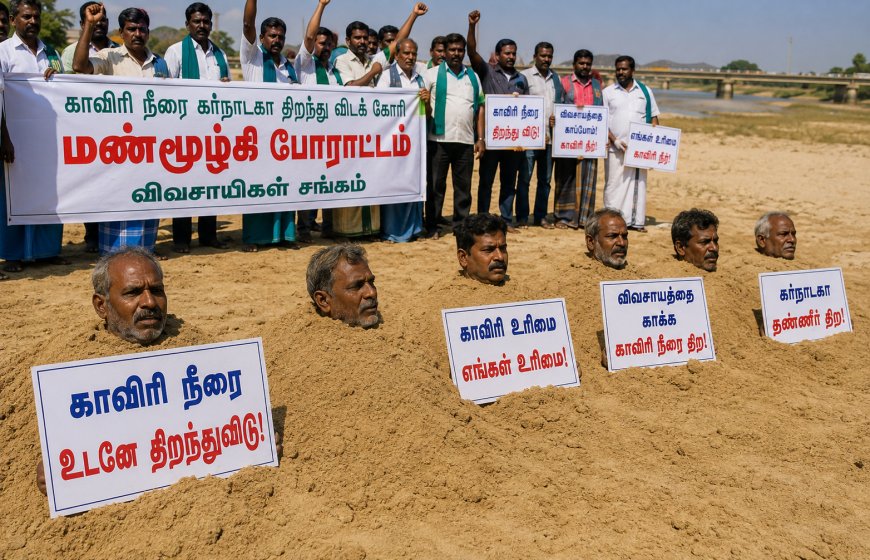
The long-standing Cauvery River water dispute between Tamil Nadu and Karnataka has once again become the center of national attention. On 3 August 2026, farmers in Tamil Nadu staged a dramatic symbolic sand-burial protest, partially burying themselves in the dry riverbed to highlight the severe water shortage affecting agriculture in the Cauvery Delta. The protest came amid renewed political tensions, legal action, and uncertainty over water releases from Karnataka.
A Symbolic Protest to Highlight Farmers' Distress
The protesters chose a striking method to convey their message. Farmers lay in the dry, sandy bed of the Cauvery River with most of their bodies covered in sand, leaving only their heads visible. According to the demonstrators, the act symbolized that without adequate Cauvery water, farming in Tamil Nadu would be "buried" and the livelihoods of thousands of agricultural families would disappear.
The demonstration was peaceful but emotionally powerful. Farmers held placards demanding that Karnataka release Tamil Nadu's allocated share of river water and urged both the Union Government and the judiciary to ensure compliance with existing legal orders. Similar symbolic protests had also been organized earlier in the year over concerns regarding the proposed Mekedatu dam and insufficient water releases.
Why the Cauvery River Is So Important
The Cauvery River is among southern India's most significant rivers. It originates in Karnataka, flows through Tamil Nadu, and eventually empties into the Bay of Bengal. Millions of people depend on it for drinking water, irrigation, fisheries, and industrial use.
For Tamil Nadu, the river is particularly important because the fertile Cauvery Delta is one of India's major rice-producing regions. Paddy cultivation, sugarcane, bananas, pulses, and several other crops depend on timely releases of water from upstream reservoirs.
Any delay or reduction in water release directly affects sowing schedules, crop growth, and farm incomes.
Historical Background of the Dispute
The Cauvery water dispute has existed for more than a century.
Major milestones include:
-
Agreements between the then Madras Presidency and Mysore Kingdom in 1892 and 1924.
-
Formation of the Cauvery Water Disputes Tribunal (CWDT) in 1990.
-
Tribunal award in 2007 allocating water among Karnataka, Tamil Nadu, Kerala, and Puducherry.
-
In 2018, the Supreme Court modified the allocation and directed implementation through institutional mechanisms including the Cauvery Water Management Authority (CWMA).
Although legal mechanisms now exist, disagreements continue almost every year, especially during years of weak rainfall.
Why the Dispute Intensified Again
This year's tensions increased because Tamil Nadu argued that Karnataka was not releasing the quantity of water directed by the CWMA.
Tamil Nadu maintained that farmers in the delta urgently required water for agricultural activities. Karnataka, however, argued that it too faced rainfall shortages and needed to conserve water for drinking purposes and local irrigation.
This conflict between upstream and downstream needs is at the heart of the Cauvery dispute.
Tamil Nadu's Legal Position
Tamil Nadu has relied heavily on legal remedies.
The ruling party sought intervention from the Supreme Court to enforce the Court's earlier judgment and the CWMA's directives requiring Karnataka to release water. According to the petition, Karnataka had failed to comply fully with the prescribed releases, making judicial enforcement necessary.
Several farmers' organisations have also demanded that negotiations should not replace the legal framework established through tribunal awards and Supreme Court decisions.
Karnataka's Stand
Karnataka maintains that water availability depends on monsoon rainfall.
Officials have argued that when reservoir storage is low, protecting drinking water supplies becomes the first priority. At the same time, Karnataka has stated that once reservoirs such as Kabini reach capacity, water naturally flows downstream and cannot simply be retained indefinitely. The state has also indicated it is prepared to pursue legal remedies to protect its interests.
Political Developments
The issue has also become highly political.
A proposed meeting between the Chief Ministers of Tamil Nadu and Karnataka was initially viewed as an opportunity to reduce tensions through dialogue. However, the meeting was postponed, reflecting the difficult political environment surrounding the dispute.
Meanwhile, several political parties and farmer organisations in Tamil Nadu criticized bilateral negotiations, arguing that the issue should instead be resolved through the CWMA and the Supreme Court.
Impact on Farmers
For farmers, the dispute is not merely political.
Without timely irrigation:
-
Paddy transplantation is delayed.
-
Crop yields decline.
-
Production costs increase.
-
Agricultural loans become harder to repay.
-
Farm labour opportunities decrease.
-
Rural incomes suffer.
Many farmers fear that repeated uncertainty over water availability could make agriculture economically unsustainable.
Drinking Water Concerns
The dispute also affects urban and rural households.
Besides agriculture, Cauvery water supplies drinking water to several cities and towns. Lower river flows can therefore increase pressure on municipal water systems, making efficient reservoir management essential for both states.
Mekedatu Dam Controversy
Another major source of disagreement is Karnataka's proposed Mekedatu dam.
Tamil Nadu believes additional upstream storage could reduce downstream flows, particularly during dry periods. Karnataka argues that the project is intended to improve drinking water security and regulate flows.
Farmer organisations and several political parties in Tamil Nadu strongly oppose the project and have organized protests demanding that it not proceed without Tamil Nadu's consent.
Public Reaction
The sand-burial protest attracted widespread public attention because of its dramatic imagery.
Many citizens expressed sympathy for farmers facing uncertain irrigation supplies, while others emphasized that long-term solutions require cooperation rather than recurring confrontations between neighboring states.
Experts note that climate variability is likely to make such disputes more frequent unless water management becomes more efficient.
Environmental Challenges
Climate change has added a new dimension to the dispute.
Changing rainfall patterns, more frequent droughts, and irregular monsoons have reduced predictability in reservoir inflows. This makes water-sharing decisions increasingly difficult for authorities.
Scientists have suggested measures such as:
-
Improved rainwater harvesting.
-
Reservoir modernization.
-
Efficient irrigation systems like drip irrigation.
-
Better groundwater management.
-
Crop diversification in water-scarce regions.
Need for Cooperative Solutions
Experts generally agree that long-term stability requires cooperation among all basin states.
Possible measures include:
-
Strict implementation of CWMA directions.
-
Transparent reservoir data sharing.
-
Scientific rainfall assessment.
-
Joint drought-management planning.
-
Faster legal dispute resolution.
-
Investment in water conservation technologies.
Such steps could reduce recurring conflicts while ensuring both drinking water security and agricultural sustainability.