Lok Sabha passes a new anti-paper leak law aimed at strengthening security for competitive examinations and imposing stricter penalties for exam paper leaks.

Lok Sabha passes a new anti-paper leak law aimed at strengthening security for competitive examinations and imposing stricter penalties for exam paper leaks.

Lok Sabha passes a new anti-paper leak law aimed at strengthening security for competitive examinations and imposing stricter penalties for exam paper leaks.

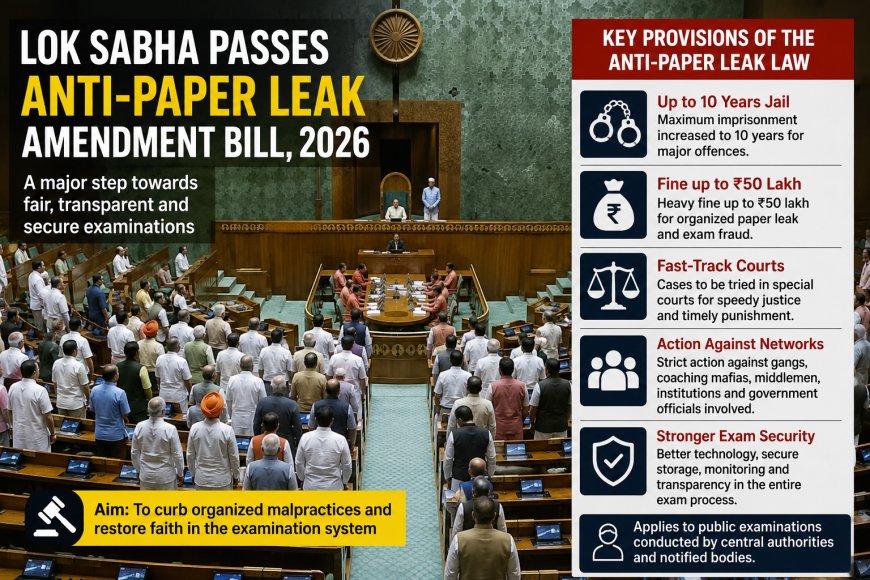
The Public Examinations (Prevention of Unfair Means) Amendment Bill, 2026 is an amendment to the 2024 law that was enacted after several high-profile paper leak incidents across India. The amendment is designed to make punishment stricter, improve investigation, and strengthen security for public examinations. It aims to protect the integrity of competitive exams that determine admission to educational institutions and recruitment to government jobs.

Why was the amendment needed?

Over the past few years, India has witnessed multiple paper leak cases affecting exams such as:

  • NEET-UG
  • UGC-NET
  • State Public Service Commission exams
  • Police recruitment exams
  • Teacher recruitment exams
  • Other state and central recruitment tests

These incidents resulted in:

  • Cancellation of examinations
  • Delays in recruitment
  • Financial losses for governments
  • Emotional stress for millions of candidates
  • Reduced public confidence in the examination system

The government stated that stronger legal provisions were necessary to deter organized exam-crime networks.

Main features of the Amendment Bill

1. Stricter punishment

The amendment increases penalties for serious offences.

For major organized paper leak offences:

  • Jail term can extend up to 10 years.
  • Fine can go up to ₹50 lakh.
  • Courts may impose both imprisonment and a fine depending on the severity of the offence.

2. Organized crime targeted

The amendment focuses not only on individuals who leak papers but also on:

  • Criminal syndicates
  • Coaching centre operators involved in fraud
  • Middlemen
  • Technology providers assisting cheating
  • Employees who misuse confidential exam material
  • Institutions participating in organized malpractice

This shifts the focus from isolated offenders to entire cheating networks.


3. Faster investigations and trials

The Bill provides for:

  • Speedier investigations
  • Faster filing of charge sheets
  • Designated courts or fast-track mechanisms where applicable

The goal is to ensure that cases are concluded promptly rather than remaining pending for years.


4. Better examination security

Authorities are expected to strengthen:

  • Digital encryption of question papers
  • Secure storage systems
  • Controlled printing procedures
  • GPS-tracked transportation of papers where needed
  • CCTV monitoring
  • Biometric verification
  • AI-assisted surveillance during examinations

Many of these are administrative measures that complement the legal changes.


5. Wider accountability

The amendment allows action against:

  • Government officials
  • Contractors
  • Examination agencies
  • Service providers
  • Anyone who knowingly assists or benefits from exam fraud

The intention is to prevent responsibility from being limited only to the person who physically leaked the paper.

Which examinations are covered?

The law primarily applies to public examinations conducted by central government authorities and notified agencies, including exams such as:

  • UPSC Civil Services
  • SSC examinations
  • Railway Recruitment Board (RRB) exams
  • National Testing Agency (NTA) examinations, such as NEET, CUET, and UGC-NET, where applicable
  • Other notified public recruitment and entrance examinations

State governments may have separate laws for state-level examinations, although they can adopt similar safeguards.

What happens if someone leaks a paper?

If investigators establish involvement in an organized paper leak:

  • A criminal case is registered.
  • Police or the designated investigating agency conducts the investigation.
  • Digital evidence, financial transactions, and communication records may be examined.
  • The accused can face prosecution under the amended law.
  • On conviction, courts may impose imprisonment, substantial fines, or both.

Impact on students

For genuine candidates, the amendment aims to:

  • Reduce the likelihood of paper leaks
  • Improve fairness in competitive examinations
  • Increase trust in government recruitment and admissions
  • Discourage cheating through stronger deterrence

Students who prepare honestly are not subject to any additional obligations under the law.

Criticism and concerns

Some education experts and opposition leaders have argued that:

  • Stronger punishments alone may not eliminate paper leaks.
  • Better cybersecurity, stricter administrative controls, and greater transparency are equally important.
  • Effective implementation and timely investigations will determine whether the law achieves its objectives.

Supporters, however, believe that combining preventive measures with tougher penalties will make organized examination fraud significantly riskier.