Total Solar Eclipse Today
Total Solar Eclipse Today
 Madhavisanvi
Total Solar Eclipse Today: A Rare Celestial Event
A total solar eclipse is taking place today, August 12, 2026, creating a major astronomical event for skywatchers around the world. During a total solar eclipse, the Moon passes directly between the Earth and the Sun and temporarily blocks the Sun's bright disk. For observers located within the narrow path of totality, daylight can briefly become much darker as the Moon completely covers the Sun.
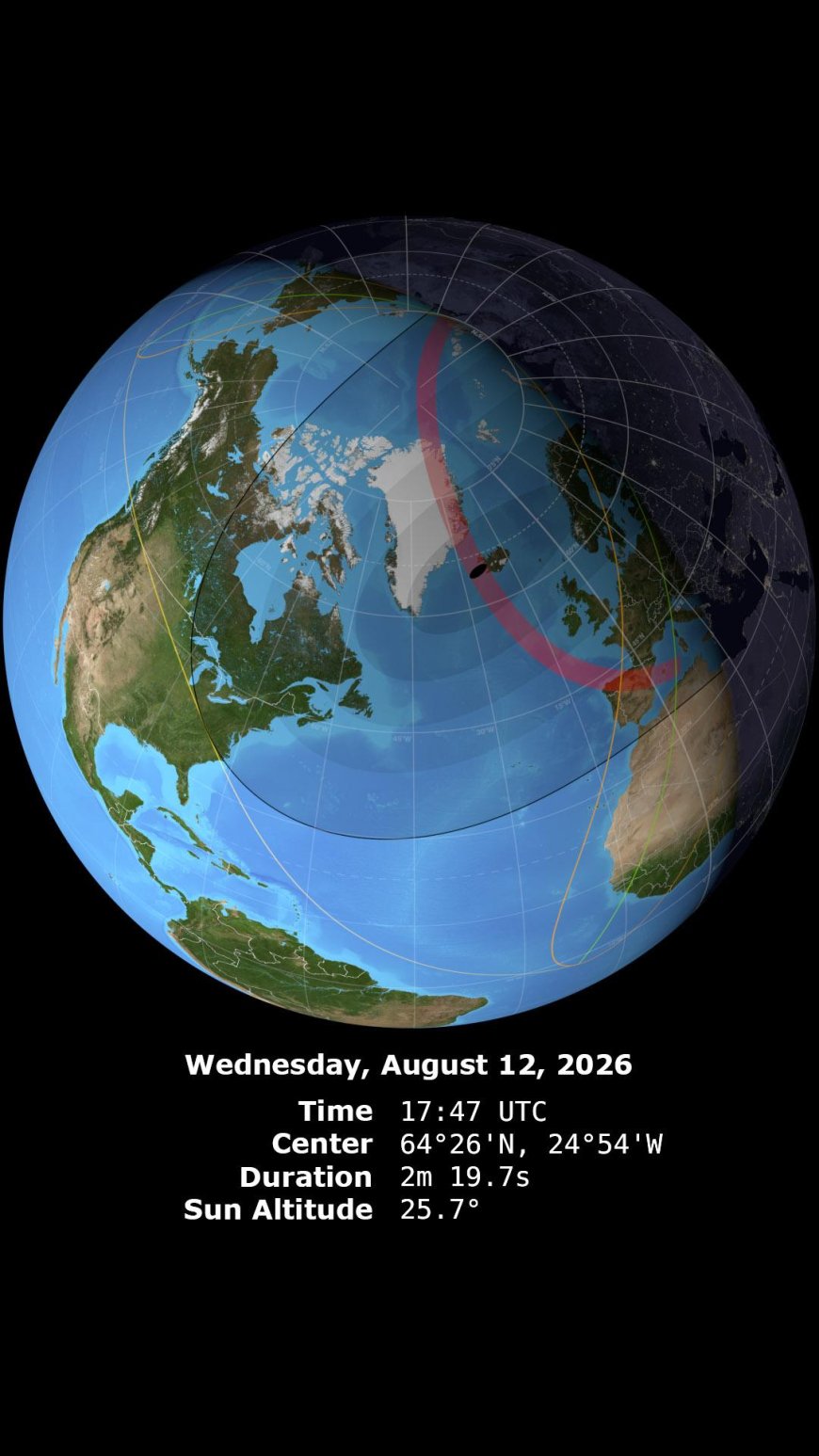
This is the only total solar eclipse of 2026, making today's event particularly significant for astronomy enthusiasts. The path of totality stretches across parts of the Northern Hemisphere, including Greenland, Iceland, northern Russia, Spain and a small part of Portugal. Other parts of Europe, North America and northwestern Africa will experience a partial solar eclipse.
What happens during a total solar eclipse?
A solar eclipse occurs when the Moon moves between the Sun and Earth and its shadow falls on Earth's surface. The Moon does not physically cover the entire Earth; instead, its shadow creates different regions of visibility.
People inside the darkest central portion of the Moon's shadow, known as the umbra, can experience totality. During totality, the Moon completely blocks the Sun's bright surface, leaving the solar corona—the Sun's outer atmosphere—visible around the Moon.
This dramatic change can make the sky appear unusually dark even though the event occurs during daytime. The temperature may also drop temporarily, while some animals can respond to the sudden change in light.
Where can the eclipse be seen?
The total eclipse will follow a relatively narrow path. According to NASA, the path crosses Greenland, Iceland, northern Russia, the Atlantic Ocean, Spain and a small corner of Portugal.
In Spain, some locations will experience totality shortly before sunset, creating the possibility of a spectacular sunset eclipse. Iceland and Greenland will experience totality later in the day, while a remote part of northern Russia will see the eclipse around midday.
Outside the path of totality, many millions of people will still be able to observe a partial solar eclipse, in which the Moon covers only part of the Sun Why India cannot see the total eclipse
For people in India, today's event is different. The total solar eclipse will not be visible from India. India lies outside the geographical region where the Moon's shadow will produce a visible eclipse.
Therefore, people in Indian cities including Delhi, Mumbai, Kolkata, Bengaluru, Chennai and Bhubaneswar will not be able to see the total eclipse from their locations.
This does not reduce the scientific importance of the event. Astronomers and space agencies around the world will observe and document the eclipse using ground-based instruments, cameras and other scientific equipment.
How long will totality last?
Totality is a relatively short phase of the eclipse. NASA says that for most locations along the path, the period when the Sun is completely covered will last less than two minutes. Near the center of the eclipse path in Greenland, Russia or the North Atlantic, totality will last somewhat longer, but still less than two and a half minutes.
Although the period is brief, totality is considered the most spectacular phase because the bright solar disk disappears and the Sun's corona becomes visible.
How should people watch a solar eclipse safely?
Solar eclipses must be observed carefully. Looking directly at the Sun during the partial phases without proper eye protection can cause serious eye injury.
NASA recommends using certified solar-viewing glasses or safe handheld solar viewers for direct observation during the partial phases. Ordinary sunglasses are not an adequate substitute.
The special situation during totality is different: when the Moon completely covers the Sun's bright disk, observers within the path of totality can briefly look at the eclipse without eye protection. However, protection must be put back on before totality ends, because the returning sunlight can become dangerous to view directly. People outside the totality path should never look directly at the Sun without appropriate solar protection, even when most of the Sun appears covered.
Why is the event scientifically important?
Total solar eclipses provide scientists with a valuable opportunity to study the Sun's corona, which is normally difficult to observe because the bright solar surface overwhelms it.
During totality, the Moon blocks the Sun's bright disk and allows the much fainter outer atmosphere to become visible. Scientists can use observations of the corona to study solar activity, magnetic structures and the behavior of the Sun's outer atmosphere.
Solar eclipses also provide opportunities for researchers to study Earth's atmosphere and the effects of a sudden reduction in sunlight.
A special spectacle in Spain
One particularly interesting feature of today's eclipse is that parts of Spain will experience totality close to sunset. This means observers may have the opportunity to see the Sun disappear behind the Moon while the sky is already approaching evening.
However, the exact viewing experience will depend heavily on local weather conditions, cloud cover and the observer's location.
A global astronomical event
Although the path of totality is narrow, the eclipse is a global astronomical event. Partial phases will be visible over a much larger area of the Northern Hemisphere, including parts of North America, Europe and northwestern Africa. This means that while only a relatively small number of people will experience complete darkness during totality, many more will have the opportunity to observe at least part of the Moon passing across the Sun.