The Sun: The Central Star of Our Solar System
The study of the Sun is a key part of Astronomy, which helps us understand the universe and our place in it.
 Avya7800
1. What is the Sun?
The Sun is a medium-sized star located at the center of our solar system. It contains about 99.86% of the total mass of the solar system, making it extremely powerful in terms of gravitational pull.
Unlike planets, which do not produce their own light, the Sun generates energy through nuclear reactions in its core. This energy radiates outward and reaches Earth in the form of sunlight.
2. Structure of the Sun
The Sun is made up of several layers, each with unique properties:
(a) Core
The core is the innermost part of the Sun, where energy is produced through a process called Nuclear Fusion. In this process, hydrogen atoms combine to form helium, releasing enormous amounts of energy.
Temperature: About 15 million °C
(b) Radiative Zone
Energy produced in the core moves outward through this layer in the form of radiation. It takes thousands of years for energy to pass through this zone.
(c) Convective Zone
In this layer, hot gases rise and cool gases sink, creating convection currents that transfer energy to the surface.
(d) Photosphere
This is the visible surface of the Sun. It emits the light that we see.
Temperature: About 5,500 °C
(e) Chromosphere
A thin layer above the photosphere, visible during solar eclipses.
(f) Corona
The outermost layer of the Sun’s atmosphere, extending millions of kilometers into space. It appears as a glowing halo during an eclipse.
3. Composition of the Sun
The Sun is primarily made of gases:
Hydrogen (about 74%)
Helium (about 24%)
Other elements (2%)
These elements exist in a plasma state due to extremely high temperatures.
4. Energy Production in the Sun
The Sun produces energy through Nuclear Fusion. In simple terms:
Hydrogen nuclei combine
Helium is formed
Energy is released
This process powers the Sun and produces sunlight and heat.
5. Importance of the Sun for Earth
The Sun is essential for life on Earth:
(a) Source of Energy
It provides heat and light necessary for survival.
(b) Photosynthesis
Plants use sunlight for Photosynthesis, producing oxygen and food.
(c) Climate and Weather
The Sun drives weather systems and ocean currents.
(d) Water Cycle
It powers evaporation, leading to rainfall.
Without the Sun, life on Earth would not exist.
6. The Sun and the Solar System
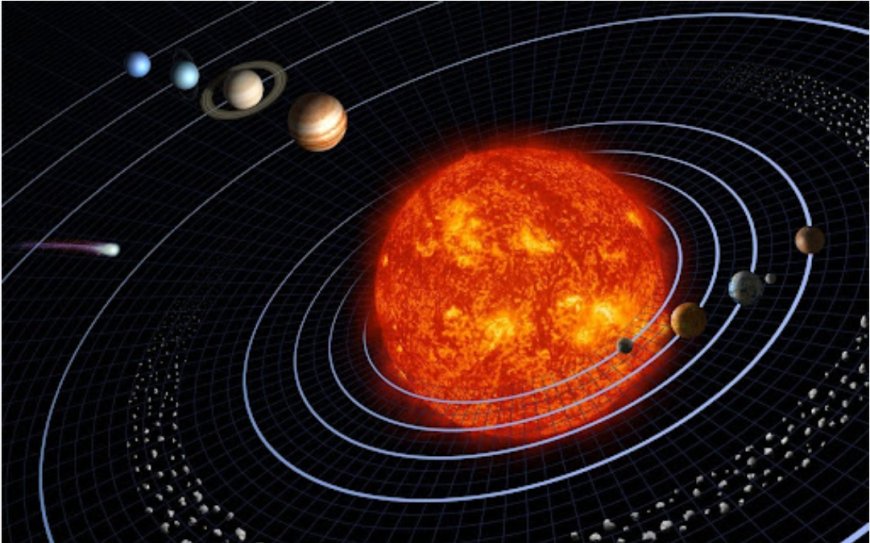
The Sun is the center of the solar system. All planets, including Earth, revolve around it due to its strong gravitational pull.
Other planets include:
Mercury
Venus
Mars
Jupiter
Saturn
Uranus
Neptune
7. Distance from Earth
The average distance between the Sun and Earth is about 150 million kilometers. This distance is called one Astronomical Unit (AU).
Sunlight takes about 8 minutes and 20 seconds to reach Earth.
8. Size and Gravity
The Sun is enormous:
Diameter: About 1.39 million km
It is about 109 times wider than Earth
Its gravity is so strong that it holds the entire solar system together.
9. Solar Phenomena
The Sun exhibits various activities:
(a) Sunspots
Dark spots on the surface caused by magnetic activity.
(b) Solar Flares
Sudden bursts of energy that release radiation.
(c) Solar Wind
A stream of charged particles flowing from the Sun.
(d) Coronal Mass Ejections
Large explosions that send particles into space.
These phenomena can affect satellites and communication on Earth.
10. Solar Energy
The Sun is a major source of renewable energy. Solar energy is:
Clean
Unlimited
Environment-friendly
Countries like India are increasingly using solar panels to generate electricity.
11. Life Cycle of the Sun
The Sun is about 4.6 billion years old and is currently in the “main sequence” stage.
In the future:
It will expand into a red giant
It may engulf nearby planets
It will eventually shrink into a white dwarf
This process will take billions of years.
12. The Sun in Culture and Religion
The Sun has been worshipped in many cultures:
In India, it is associated with the Sun God Surya
Many festivals and rituals honor the Sun
It symbolizes life, energy, and power.
13. Effects of the Sun on Human Life
While the Sun is essential, too much exposure can be harmful:
Sunburn
Skin damage
Heatstroke
Moderate exposure is important for Vitamin D production.
14. Scientific Study of the Sun
Scientists study the Sun using:
Telescopes
Satellites
Space missions
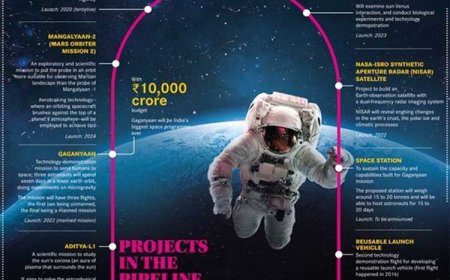
Missions like Aditya-L1 aim to understand solar activity and its impact on Earth.
15. Interesting Facts About the Sun
The Sun is about 4.6 billion years old
It produces energy continuously
Light from the Sun takes 8 minutes to reach Earth
It is one of billions of stars in the galaxy
Conclusion
The Sun is the heart of our solar system and the ultimate source of energy for life on Earth. As a powerful star, it controls the motion of planets, supports ecosystems, and influences climate and weather.
Through processes like Nuclear Fusion, the Sun produces enormous energy that sustains life. Its importance extends beyond science into culture, religion, and daily life.