Where Does Oxygen Come From? – A Brief Description
Oxygen is one of the most essential elements for life on Earth. Every human, animal, and many microorganisms depend on oxygen for survival. It is a major component of the air we breathe and plays a vital role in respiration, energy production, and maintaining life processes.
 Avya7800
1. Oxygen in the Atmosphere
The Earth’s atmosphere contains about 21% oxygen, making it the second most abundant gas after nitrogen. This oxygen is not static; it is constantly being produced and consumed through various natural processes.
The balance of oxygen in the atmosphere is maintained through a cycle involving photosynthesis and respiration. Without this balance, life on Earth would not be possible.
2. Main Source: Photosynthesis
The primary source of oxygen on Earth is a process called Photosynthesis. This process occurs in green plants, algae, and some bacteria.
During photosynthesis, plants use sunlight, carbon dioxide, and water to produce food (glucose) and release oxygen as a byproduct.
Here is how it works:
Plants absorb sunlight through their leaves
They take in carbon dioxide from the air
They absorb water from the soil through roots
Using sunlight energy, they convert these into food
Oxygen is released into the atmosphere
This oxygen is what we breathe.
3. Role of Green Plants
Green plants are one of the largest contributors to oxygen production. Trees, grasses, and other plants continuously produce oxygen during the day when sunlight is available.
Forests, especially tropical rainforests like the Amazon, are often called the “lungs of the Earth” because they produce large amounts of oxygen. However, they also consume oxygen at night through respiration, so their net contribution is balanced.
Plants also help maintain the carbon dioxide-oxygen balance, which is essential for climate stability.
4. Ocean: The Largest Oxygen Producer
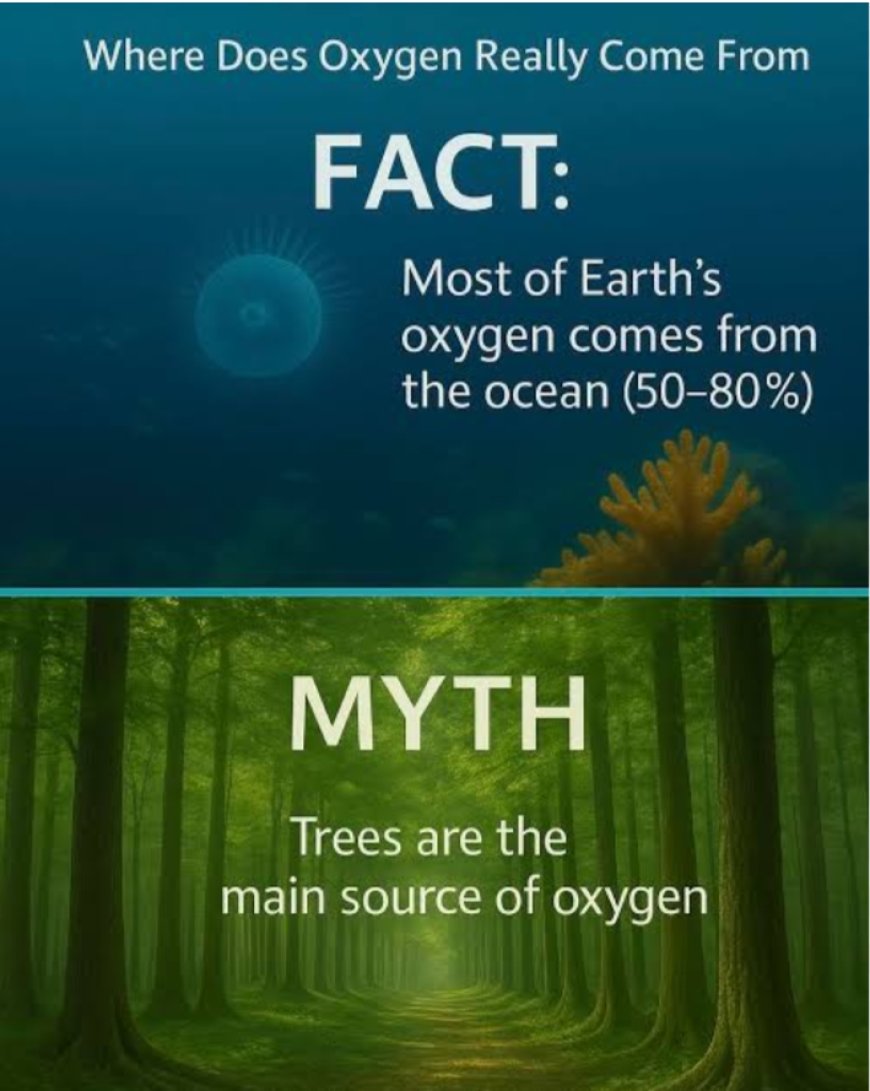
Many people think forests are the main source of oxygen, but in reality, the oceans produce more than half of the world’s oxygen.
Tiny organisms in the ocean called phytoplankton play a major role. These microscopic plants float on the surface of oceans and perform photosynthesis just like land plants.
Phytoplankton, along with algae and cyanobacteria, contribute approximately 50–70% of Earth’s oxygen. This makes oceans the most important source of oxygen on the planet.
5. Role of Algae and Cyanobacteria
Algae are simple plant-like organisms found in water. They range from tiny microscopic forms to large seaweeds. Like plants, they perform photosynthesis and release oxygen.
Cyanobacteria, also known as blue-green algae, are among the earliest organisms on Earth to produce oxygen. Billions of years ago, they played a crucial role in increasing oxygen levels in the atmosphere.
This event, known as the Great Oxygenation Event, transformed Earth’s atmosphere and made it possible for complex life to evolve.
6. The Oxygen Cycle
Oxygen is part of a continuous natural cycle called the oxygen cycle. In this cycle:
Plants and algae produce oxygen through photosynthesis
Animals and humans consume oxygen during respiration
Carbon dioxide is released during respiration
Plants reuse carbon dioxide for photosynthesis
This cycle keeps the levels of oxygen and carbon dioxide balanced in the atmosphere.
7. Oxygen from Water
Oxygen released during photosynthesis actually comes from water molecules (H₂O), not carbon dioxide. When plants split water molecules using sunlight, oxygen is released as a byproduct.
This process is known as photolysis. It shows how important water is not only for life but also for oxygen production.
8. Minor Sources of Oxygen
Apart from photosynthesis, there are a few minor sources of oxygen:
a. Photodissociation
In the upper atmosphere, ultraviolet (UV) radiation from the Sun can split water vapor into hydrogen and oxygen.
b. Chemical Reactions
Some natural chemical reactions in the Earth’s crust can release small amounts of oxygen.
However, these sources contribute very little compared to photosynthesis.
9. Consumption of Oxygen
Oxygen is constantly being used by living organisms and natural processes:
Humans and animals use oxygen for breathing
Microorganisms use oxygen for decomposition
Combustion (burning of fuels) consumes oxygen
Industrial processes use oxygen
Despite this continuous consumption, oxygen levels remain stable due to constant production by plants and marine organisms.
10. Importance of Oxygen
Oxygen is essential for many life processes:
a. Respiration
It helps release energy from food in living cells.
b. Combustion
Oxygen supports burning, which is important for energy production.
c. Ozone Formation
Oxygen forms ozone (O₃), which protects Earth from harmful ultraviolet radiation.
d. Aquatic Life
Dissolved oxygen in water supports fish and other aquatic organisms.
11. Human Impact on Oxygen Sources
Human activities are affecting oxygen production:
a. Deforestation
Cutting down forests reduces the number of plants that produce oxygen.
b. Pollution
Air and water pollution harm plants, algae, and phytoplankton.
c. Climate Change
Rising temperatures and ocean acidification affect marine life, including oxygen-producing organisms.
d. Industrial Activities
Burning fossil fuels consumes oxygen and increases carbon dioxide levels.
12. Conservation of Oxygen Sources
To maintain oxygen levels, it is important to protect natural sources:
Plant more trees (afforestation)
Protect forests and ecosystems
Reduce pollution
Conserve oceans and marine life
Use renewable energy sources
These steps help ensure a steady supply of oxygen for future generations.
13. Interesting Facts About Oxygen
Oxygen is colorless, odorless, and tasteless.
It is the most abundant element in the Earth’s crust.
Humans can survive only a few minutes without oxygen.
About 90% of the human body’s energy production depends on oxygen.
Oceans produce more oxygen than forests.
Conclusion
Oxygen, the gas essential for life, mainly comes from the process of Photosynthesis, carried out by plants, algae, and microscopic organisms like phytoplankton. While forests play an important role, oceans are the largest producers of oxygen on Earth.
The continuous cycle of oxygen production and consumption maintains the balance necessary for life. However, human activities are threatening these natural sources, making conservation efforts more important than ever.
In conclusion, oxygen is not just a gas we breathe—it is a vital component of Earth’s life-support system. Protecting its sources ensures the survival of all living beings on our planet.