RBI Keeps Repo Rate Unchanged at 5.25%: Detailed Explanation

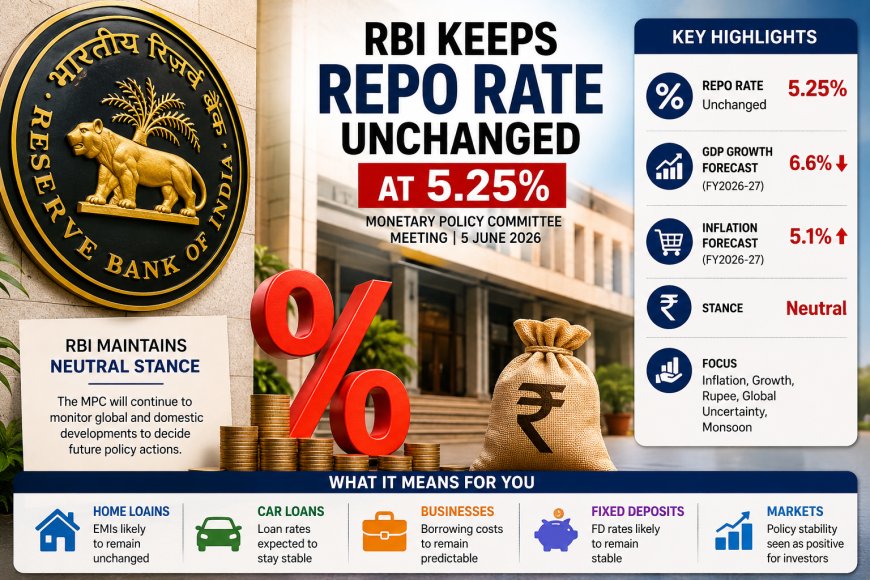
On 5 June 2026, the Reserve Bank of India (RBI) announced that it would keep the repo rate unchanged at 5.25%. The decision was taken unanimously by the Monetary Policy Committee (MPC), which also retained its neutral policy stance. This is one of the most important economic decisions affecting borrowers, businesses, investors, banks, and the overall Indian economy.
What Is the Repo Rate?
The repo rate is the interest rate at which the RBI lends money to commercial banks for short-term needs.
In simple terms:
- RBI = India's central bank
- Banks borrow money from RBI
- The interest charged by RBI is called the repo rate
When the repo rate changes, banks usually adjust their lending and deposit rates accordingly.
For example:
- Lower repo rate → cheaper loans
- Higher repo rate → expensive loans
- Unchanged repo rate → stability in borrowing costs
The current repo rate remains at 5.25%.
Why Did RBI Keep the Repo Rate Unchanged?
The RBI faces a difficult balancing act.
It must:
- Control inflation
- Support economic growth
- Maintain financial stability
- Protect the rupee
Currently, several global and domestic risks are creating uncertainty.
1. Rising Crude Oil Prices
India imports most of its crude oil requirements.
Recent geopolitical tensions in West Asia have pushed oil prices upward. Higher oil prices increase transportation costs, manufacturing expenses, and fuel prices.
As a result:
- Petrol and diesel may become costlier
- Freight costs rise
- Goods become expensive
- Inflation increases
The RBI is carefully monitoring this situation before making any rate changes.
2. Weakening Rupee
The Indian Rupee has been under pressure against the US Dollar.
A weaker rupee makes imports more expensive, including:
- Crude oil
- Electronics
- Machinery
- Chemicals
This can increase inflation further.
Instead of raising interest rates immediately, RBI has chosen to monitor the situation while using other measures to support the currency.
3. Global Uncertainty
The world economy is facing several challenges:
- Geopolitical conflicts
- Supply chain disruptions
- Energy market volatility
- Slower global growth
These factors can affect India's exports, imports, investments, and inflation outlook.
Because of these uncertainties, RBI has chosen a cautious approach.
4. Monsoon Concerns
India's agriculture depends heavily on monsoon rainfall.
A weak monsoon can lead to:
- Lower crop production
- Higher food prices
- Increased inflation
The RBI has identified weather-related risks as an important factor affecting future policy decisions.
What Is a Neutral Stance?
Along with keeping the repo rate unchanged, RBI maintained a "neutral" stance.
A neutral stance means:
- RBI is not committing to future rate hikes.
- RBI is not committing to future rate cuts.
- Future decisions will depend on economic data.
This gives the central bank flexibility.
If inflation rises sharply, RBI may increase rates.
If economic growth weakens significantly, RBI may reduce rates.
For now, RBI prefers to wait and watch.
Impact on Home Loans
For home loan borrowers, the decision is largely positive.
Since the repo rate remains unchanged:
- Existing EMIs are unlikely to rise immediately.
- Floating-rate home loans should remain stable.
- New borrowers can expect similar interest rates.
For example:
A ₹50 lakh home loan for 20 years will generally continue at current lending rates rather than becoming more expensive.
This provides stability for families planning home purchases.
Impact on Personal Loans
Personal loan rates are also likely to remain stable.
Banks determine personal loan rates based on:
- Repo rate
- Credit risk
- Market conditions
Since RBI has not changed rates, banks are not under immediate pressure to revise lending rates.
Borrowers should not expect major changes in personal loan costs in the short term.
Impact on Car Loans
Car buyers also benefit from rate stability.
When interest rates remain unchanged:
- Monthly instalments remain predictable.
- Automobile financing stays affordable.
- Consumer confidence remains stronger.
This can support demand in the automobile sector.
Impact on Businesses
Businesses closely watch RBI policy decisions.
Stable rates help companies:
- Plan investments
- Manage borrowing costs
- Expand operations
- Hire employees
If rates had increased, borrowing would become more expensive.
By maintaining rates, RBI is providing a stable environment for businesses while monitoring inflation risks.
Impact on Small Businesses
Small and medium enterprises (SMEs) depend heavily on bank loans.
An unchanged repo rate means:
- Working capital costs remain manageable.
- Expansion plans can continue.
- Cash-flow planning becomes easier.
For entrepreneurs and startups, policy stability is generally viewed positively.
Impact on Fixed Deposits (FDs)
FD investors often watch RBI decisions carefully.
Since rates remain unchanged:
- FD rates are likely to remain broadly stable.
- Banks may not significantly increase deposit rates.
- Existing FD investors continue earning current returns.
However, individual banks can still adjust rates based on liquidity conditions.
Impact on Stock Market
Stock markets usually react to RBI policy decisions.
The market was largely expecting the RBI to keep rates unchanged.
As a result:
- Banking stocks may remain stable.
- Rate-sensitive sectors such as housing and automobiles may benefit.
- Investors will now focus on inflation and growth forecasts.
Market participants often view policy certainty positively.
Inflation Outlook
One major concern is inflation.
The RBI increased its inflation forecast for FY2026-27 to around 5.1% because of:
- Rising oil prices
- Supply chain disruptions
- Global uncertainties
- Weather-related risks
Although inflation remains within RBI's tolerance band, risks have increased.
GDP Growth Forecast
The RBI has lowered its GDP growth forecast to approximately 6.6%.
Reasons include:
- Global economic uncertainty
- Higher energy costs
- Supply chain challenges
- Geopolitical tensions
Despite the reduction, India's growth remains among the strongest among major economies.
Why Didn't RBI Increase Rates?
Some economists argued that higher inflation risks justified a rate hike.
However, RBI believes:
- Current inflation remains manageable.
- Economic growth needs support.
- External shocks may be temporary.
- More data is needed before tightening policy.
Therefore, RBI chose patience rather than immediate action.
Why Didn't RBI Cut Rates?
Others expected a rate cut to support growth.
However, cutting rates now could:
- Increase inflation pressures.
- Weaken the rupee further.
- Encourage excessive borrowing.
Because inflation risks remain elevated, RBI avoided reducing rates.
What Happens Next?
The future path of interest rates will depend on:
Inflation
If inflation rises significantly, RBI may raise rates.
Oil Prices
If crude oil prices continue increasing, inflation could worsen.
Monsoon Performance
A good monsoon can reduce food inflation.
Global Conditions
Improved global stability may reduce economic risks.
Rupee Movement
A stable rupee can help contain imported inflation.
The RBI has made it clear that future decisions will be data-driven.
Conclusion
The RBI's decision to keep the repo rate unchanged at 5.25% reflects a cautious and balanced approach. The central bank is attempting to protect economic growth while remaining vigilant about inflation risks arising from higher oil prices, geopolitical tensions, supply-chain disruptions, monsoon uncertainty, and a weaker rupee. The Monetary Policy Committee has also retained a neutral stance, signaling flexibility for future action depending on how economic conditions evolve.
For ordinary citizens, the immediate impact is stability. Home loan EMIs, car loans, business borrowing costs, and fixed deposit rates are expected to remain broadly unchanged. For businesses and investors, the decision provides predictability during a period of global uncertainty. While growth projections have been slightly reduced and inflation forecasts raised, India's economy continues to show resilience. The next few months—especially developments in oil prices, inflation, the monsoon, and global markets—will determine whether the RBI eventually cuts rates, keeps them unchanged, or begins raising them again.
Madhavisanvi