The Bhubaneswar Municipal Corporation (BMC) issued a 7-day ultimatum to over 4,600 residential properties utilizing residential premises for illegal commercial operations.
The Bhubaneswar Municipal Corporation (BMC) issued a 7-day ultimatum to over 4,600 residential properties utilizing residential premises for illegal commercial operations.
 Madhavisanvi
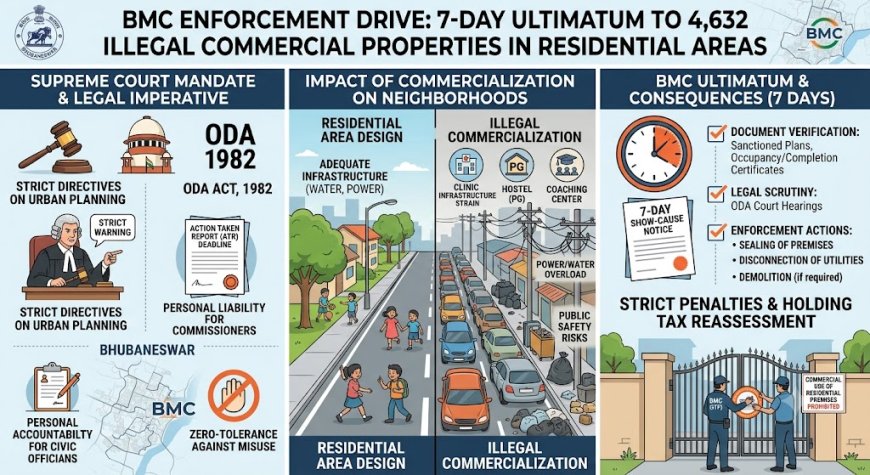
The Bhubaneswar Municipal Corporation (BMC) has launched a massive enforcement drive targeting the rampant misuse of residential premises for commercial activities across the Odisha capital. Following strict directives from the Supreme Court of India, the civic body identified 4,632 residential properties operating illegally as commercial hubs, issuing public notices and show-cause orders demanding immediate legal compliance.
                 ┌──────────────────────────────────────────────────┐
                 │  4,632 Identified Non-Compliant Residential Plots │
                 └────────────────────────┬─────────────────────────┘
                                          │
       ┌──────────────────────────────────┼──────────────────────────────────┐
       ▼                                  ▼                                  ▼
┌──────────────┐                   ┌──────────────┐                   ┌──────────────┐
│  North Zone  │                   │ S-West Zone  │                   │ S-East Zone  │
│ 1,712 Plots  │                   │ 1,540 Plots  │                   │ 1,380 Plots  │
└──────────────┘                   └──────────────┘                   └──────────────┘
Supreme Court Catalyst & Legal Imperative
The civic body's aggressive posture stems directly from ongoing proceedings in the Supreme Court of India regarding urban planning enforcement (Loganathan vs State of Tamil Nadu & Others).
-
Apex Court Warning: During hearings in May and July 2026, the Supreme Court expressed deep dissatisfaction over the widespread, unchecked conversion of residential buildings into commercial enterprises across Indian municipalities.
-
Personal Accountability: The court explicitly warned Municipal Commissioners and executive heads of local bodies that they would be held personally liable for contempt if meaningful enforcement—including sealing, closure, and demolition—was not executed against non-compliant properties.
-
Mandate for Action: In response, BMC Commissioner Chanchal Rana and senior leadership deployed field verification teams across all 67 wards to compile comprehensive lists of unauthorized property conversions and present an Action Taken Report (ATR) to the apex court.
Breakdown of Violations & Affected Zones
Field verification by BMC personnel revealed that residential buildings approved by the Bhubaneswar Development Authority (BDA) were systematically converted into high-density commercial establishments without proper zoning approvals or revised sanctioned plans.
  Commercial Misuse Identified in Residential Buildings
  ├── Private Clinics & Diagnostics
  ├── Hostels & Paying Guest (PG) Accommodations
  ├── Educational & Coaching Institutes
  ├── Retail Outlets & Grocery Stores
  └── Corporate Offices & Hospitality Centers
The 4,632 properties identified across the city are distributed across BMC's three main administrative zones:
-
North Zone (1,712 Properties): Encompasses rapidly expanding IT and educational corridors including Patia, Chandrasekharpur, Damana, and Jaydev Vihar. Many residential houses here were illegally converted into student hostels, paying guest accommodations, cafes, and private coaching centers.
-
South-West Zone (1,540 Properties): Spans dense residential pockets like Suryanagar, Nayapalli, and BDA Colony.
-
South-East Zone (1,380 Properties): Covers established commercial-residential hubs such as Saheed Nagar, Bapuji Nagar, Satya Nagar, Acharya Vihar, Laxmisagar, and Jharapada.
Legal Provisions & Ultimate Ultimatum
The enforcement drive derives its statutory authority from the Odisha Development Authorities (ODA) Act, 1982, alongside the Planning and Building Standards Regulations.
| Enforcement Dimension | Statutory Mandate & Administrative Policy |
| Notice Mandate | Property owners must produce valid sanctioned building plans, occupancy/completion certificates, or land-use conversion approvals before the Zonal Deputy Commissioner (ZDC) or ODA Court. |
| Consequence of Non-Compliance | Failure to furnish lawful documentation will result in the property being declared an "unauthorized structure". The premises face immediate closure, administrative sealing, disconnection of basic utilities, or demolition without further warning. |
| Holding Tax Reassessment | BMC is reclassifying properties from residential tax slabs to commercial rates, penalizing owners who underreported commercial usage to pay lower residential taxes. |
Infrastructure Strain & Public Policy Justification
Beyond legal compliance, the BMC's action addresses urban planning challenges created by unregulated commercialization in residential neighborhoods:
-
Traffic & Parking Bottlenecks: Residential streets designed for quiet neighborhood traffic become congested when converted into retail strips or private clinics, causing illegal street parking and emergency access blockages.
-
Infrastructure Overload: Commercial units consume significantly more electricity and water and generate higher volumes of solid waste and sewage than standard households, placing severe strain on localized municipal grids.
-
Loss of Municipal Revenue: Operating commercial businesses on residential holdings deprives the civic body of substantial holding tax revenues. While commercial tax rates are significantly higher, thousands of property owners continued paying low residential tariffs while generating high commercial income.